

Can Knee Replacement Be Avoided? Complete Guide by the Best Knee Replacement Surgeon in Delhi NCR
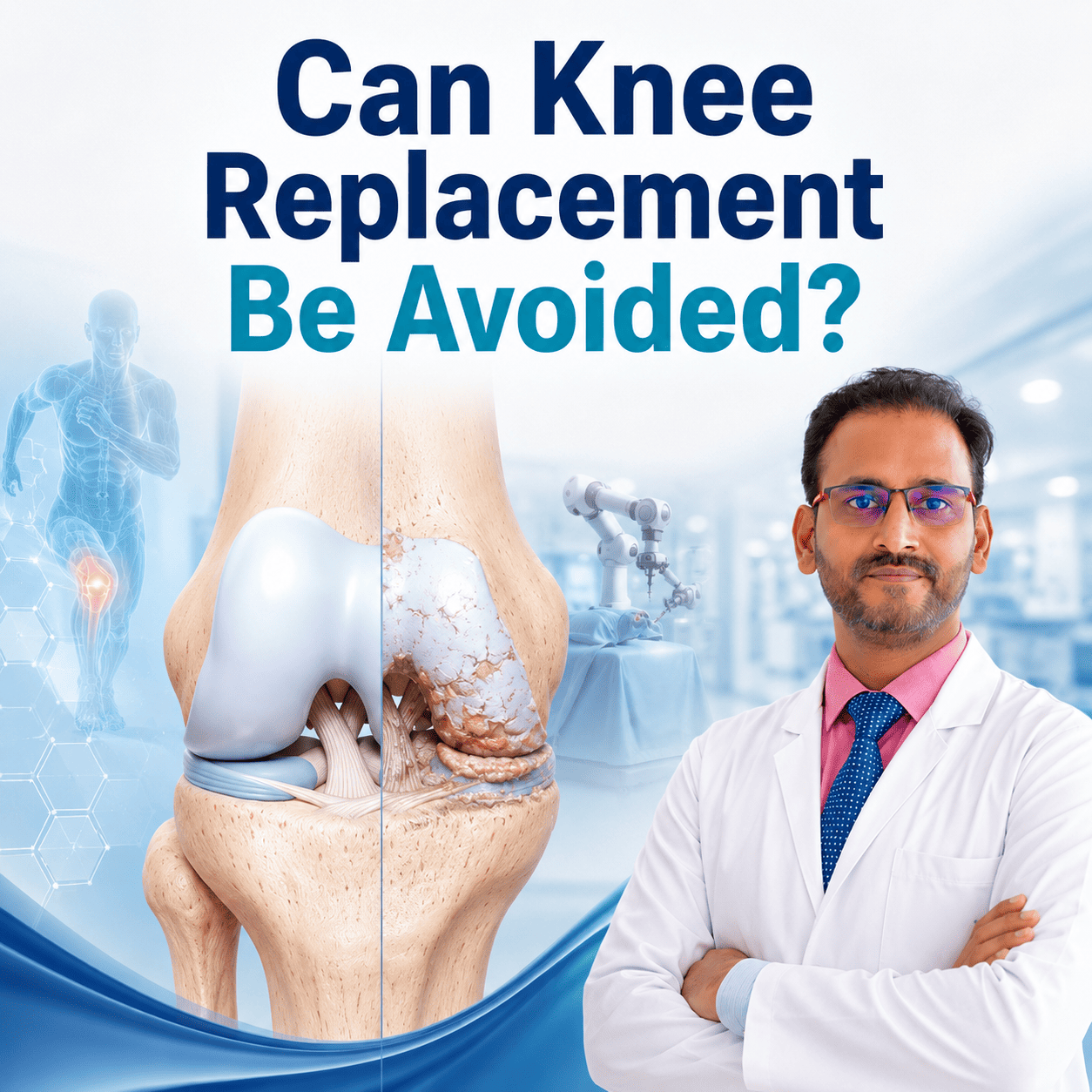
By Dr Amit Kumar Srivastava — Senior Orthopaedic Surgeon & Joint Preservation Specialist
Yes, weight management, physiotherapy, and the right injections can typically delay or prevent the need for knee replacement in early- to moderate-stage arthritis. However, when cartilage gets severely injured and conservative treatments are no longer effective, surgery is the most effective option to relieve discomfort and restore mobility.
“Doctor, do I really need a knee replacement?” That is the question I hear most often in my clinic. Patients arrive after years of painkillers, physiotherapy, and ointments, hoping for an honest answer. This guide gives you exactly that.
A lot of patients looking for the best knee replacement surgeon in Delhi NCR do not plan to have surgery right away. They want a candid opinion on whether surgery can be postponed or avoided. This guide describes when conservative treatment is effective, when surgery is required, and how to make the best choice.
What Damages the Knee Over Time?
The knee joint depends on smooth cartilage to move without friction. When that cartilage wears down, gradually or after injury, pain, stiffness, and disability follow. The most common causes leading to knee replacement surgery in Delhi NCR and globally are:
| Cause | Who It Affects | Key Feature |
| Osteoarthritis | Adults over 50 | The most prevalent reason for knee replacement is gradual cartilage degeneration. |
| Rheumatoid Arthritis | Any age | The immune system attacks the joint; it moves more quickly. |
| Post-Traumatic Arthritis | Younger, active patients | Follows old fractures, ACL tears, or meniscus injuries |
| Obesity | All age groups | Every additional kg puts approximately 4 kg of pressure on the knee. |
| Avascular Necrosis | Varies | Blood supply to the bone is disturbed; bone tissue dies. |
| Genetic / Alignment Issues | Family history | Bow legs, knock knees, and joint shape all increase wear. |
When Should You See an Orthopaedic Surgeon?
Many patients wait too long. These early signals mean your knee needs a proper evaluation, not just more painkillers:
- Morning stiffness that lasts over 30 minutes.
- Pain gets worse when walking, squatting, or climbing stairs.
- Persistent swelling or warmth around the joint.
- A grinding, clicking, or catching sensation within the knee.
- Difficulties with fully straightening or bending the knee.
- Knee discomfort interrupts sleep.
- Visible changes in leg alignment (bowing or knock-knee).
- Pain that no longer responds to conventional treatments.
Consulting the best knee replacement surgeon in Delhi NCR early does not mean you will be advised to undergo surgery. An experienced specialist can accurately diagnose the stage of arthritis and recommend treatments that may preserve your natural knee for years.
|
Dr Amit Kumar Srivastava Note |
| Early evaluation does not mean early surgery. It means early options, and those give you the best chance of avoiding surgery altogether. |
Non-Surgical Treatments That Actually Work
A structured, conservative treatment for early- to advanced-stage knee arthritis significantly reduces pain, slows progression, and delays or prevents the need for knee replacement surgery in Delhi. These are evidence-based options, not conjecture.
1. Weight Management
One of the first recommendations from the best knee replacement surgeon in Delhi NCR is effective weight management. Even losing 5-10% of body weight significantly reduces pressure on the knee joint.
2. Physiotherapy & Targeted Exercise
A structured exercise plan improves the muscles that surround the knee, particularly the quadriceps, which act as natural shock absorbers. The American Academy of Orthopaedic Surgeons (AAOS) supports physiotherapy as a first-line treatment based on good clinical evidence. Swimming and cycling are low-impact activities that protect cartilage while also keeping you fit.
3. Medications
NSAIDs efficiently reduce inflammation in mild to severe pain. Topical anti-inflammatory gels provide targeted relief with fewer adverse effects. Disease-modifying medicines (DMARDs) are vital for slowing joint degeneration in rheumatoid arthritis and are recommended by a rheumatologist in addition to orthopaedic therapy.
4. Knee Braces & Orthotics
Custom-fitted braces shift stress away from the injured compartment of the knee. Corrective shoe insoles assist individuals who have gait irregularities that cause uneven strain on their joints.
5. Hyaluronic Acid (Viscosupplementation) Injections
Gel-like injections into the knee joint help boost natural joint fluid, enhancing lubrication and cushioning. Corrective shoe insoles assist individuals who have gait irregularities that cause uneven strain on their joints. Most effective in early-to-moderate arthritis, it can provide considerable relief for 6-12 months in the proper patients.
6. PRP (Platelet-Rich Plasma) Therapy
PRP uses your own blood, which is concentrated for growth factors and injected into the knee. It has been shown in studies to reduce inflammation and improve joint function in people with mild to moderate arthritis. Results vary between patients, but it is increasingly used as part of a multi-modal approach for knee arthritis treatment in Delhi NCR.
7. Activity Modification
Avoiding high-impact activities on hard surfaces (like running on asphalt) while staying mobile through low-impact exercise protects remaining cartilage without worsening pain.
When Conservative Treatment Is No Longer Enough
At this stage, consultation with the best knee replacement surgeon in Delhi NCR becomes important to determine whether joint-preserving treatments are still appropriate or if surgery offers the best long-term outcome, which is:
- Pain is constant, present at rest and at night
- Walking more than 500 metres is no longer possible without significant pain
- Several physiotherapy courses have delivered diminishing results
- Injections that once lasted 6 months now provide only weeks of relief
- X-rays show bone-on-bone contact or significant joint space loss
- Joint deformity (bowing or knock-knee) is visibly worsening
- Sleep, mood, and daily independence are seriously affected
| Important |
| Achieving this degree is not always a failure of treatment. It means the joint has advanced past what conservative control can competently cope with, and surgical operation at this point is a medically sound decision, not a closing in cried from desperation. |
Best Knee Replacement Surgery in Delhi NCR: What Modern Surgery Offers
Knee replacement today is very different from what it was even 10 years ago. The procedure, recovery timeline, and long-term outcomes have all improved significantly. For patients exploring the best knee replacement surgery in Delhi NCR, here is what advanced surgical care now offers:
Robotic-Assisted Knee Replacement
The robotic technology generates a 3D model of your unique anatomy from a pre-operative CT scan. During surgery, it gives real-time haptic guidance, allowing bone cuts to be precise down to the millimetre. As a result, implants are more aligned, knee mobility feels more natural, and there is a lower risk of long-term revision. Robotic knee replacement surgery in Delhi NCR is now accessible at specialised joint replacement centres staffed by competent surgeons.
Minimally Invasive Technique
Smaller incisions mean less muscle damage, less blood and faster healing. During surgery, it gives real-time haptic guidance, allowing bone cuts to be precise down to the millimetre. Minimally invasive knee replacement surgery in Delhi is not appropriate for all patients; anatomy and implant needs dictate eligibility, although the technique is currently more extensively employed than ever before.
ERAS Protocol Faster Recovery
Enhanced Recovery After Surgery (ERAS) protocols include improved pre-operative preparation, multimodal pain treatment, and early mobilisation. The majority of patients can walk with support within 24 hours after surgery and are discharged within 3-5 days.
Modern Implants
The latest knee replacement technology in Delhi NCR uses high-quality materials such as cobalt-chrome alloys, titanium, and cross-linked polyethene. According to national joint registry data, modern implants are expected to survive 15-25 years, with 85-90% remaining functional after 15-20 years.
| Robotic-Assisted | Conventional | |
| Bone Cut Accuracy | Sub-millimetre precision | Surgeon-dependent |
| Implant Alignment | Computer-guided | Standard jig-based |
| Soft Tissue Balancing | Real-time haptic feedback | Manual assessment |
| Recovery Speed | Typically faster | Standard |
| Revision Risk | Lower with accurate placement | Higher with malalignment |
| Patient-Specific Planning | Yes (3D CT modelling) | No |
Who Is a Candidate for Knee Replacement?
Surgery is considered when:
- Moderate-to-severe osteoarthritis, rheumatoid arthritis, or post-traumatic arthritis. arthritis confirmed clinically and on X-ray.
- Significant functional limitation despite adequate conservative treatment.
- Stable general health to tolerate surgery and anaesthesia.
- No active infection in or around the knee.
- Realistic recovery expectations.
Age is not the determining factor. Modern implants and robotic joint replacement in Delhi NCR make knee replacement an option for people in their 40s and 50s when it is truly required. Morbid obesity raises the risk; hence, weight loss before surgery is recommended.
Recovery Timeline After Total Knee Replacement Surgery
|
Phase |
Timeframe |
What to Expect |
|
Immediate Post-Op |
Day 0–1 |
Standing and first steps with support |
|
Early Recovery |
Week 1–2 |
Discharge home, physiotherapy begins |
|
Functional Recovery |
Week 2–6 |
Walking without support, performing light daily tasks |
|
Active Rehabilitation |
Week 6–12 |
Stairs, driving (6+ weeks), workplace return |
|
Full Functional Recovery |
3–6 months |
Walking, light sport, social activities |
|
Long-Term Outcome |
1 year+ |
Near-normal function, sustained pain relief |
How to Choose the Best Knee Replacement Surgeon in Delhi NCR
The outcome of total knee replacement surgery in Delhi depends heavily on the surgeon’s experience, technology, and post-operative care. If you are looking for the best knee replacement surgeon in Delhi NCR, consider more than online reviews. Experience in complex joint replacement, robotic-assisted surgery, patient outcomes, and comprehensive rehabilitation all contribute to better results. Look for:
- A joint replacement expert and not a general orthopaedic consultant.
- Experience with complicated revision cases as well as robotic knee replacement surgery in Delhi.
- Access to sophisticated surgical technology (robotic guidance, patient-specific equipment) represents advanced knee replacement surgery in Delhi.
- A hospital with robust infection control and rehabilitation facilities is what a true knee replacement hospital in Delhi should offer.
- Transparent communication, surgery is mentioned only when truly indicated.
- A comprehensive post-operative physiotherapy plan.
- Thorough pre-operative evaluation, including specialist X-rays and cardiac assessment when needed, is the standard at a leading joint replacement centre in Delhi NCR.
| Do not wait for your knee to get worse before seeking help. By the time bone-on-bone pain is constant, 70–80% of your cartilage may already be gone. Act at the first sign of early arthritis, that is, when preservation works best. |
Frequently Asked Questions About Orthopedic Care
Can knee replacement be avoided permanently?
Surgery may be avoided in the long run for people with mild to moderate arthritis who maintain a healthy weight, exercise regularly, and take suitable medications. Osteoarthritis progresses, but in advanced cases, surgery may be required to restore quality of life.
Is walking good for knee arthritis?
Yes, in most cases. Walking on even surfaces maintains muscle strength and joint mobility. Intensity and duration should match the severity of arthritis; a physiotherapist or knee pain specialist in Delhi NCR can advise on the right level for your condition.
What is the best alternative to knee replacement?
There is no single answer; it depends on the stage of arthritis. For mild-to-moderate cases, a combination of weight management, physiotherapy, medications, and joint injections works well. For selected younger patients with isolated compartment damage, partial knee replacement surgery in Delhi may be an appropriate surgical alternative to total replacement.
At what stage is knee replacement necessary?
Typically, when X-rays show Grade 3-4 osteoarthritis, pain is severe and persistent despite 6+ months of well-managed conservative treatment, and daily function is significantly compromised. Every expert knee replacement surgeon in Delhi NCR takes a personalised strategy while making a decision.
How successful is robotic knee replacement surgery?
Published studies consistently show better implant alignment, more accurate ligament balancing, and higher patient satisfaction compared to conventional techniques. Satisfaction rates above 90% are reported in appropriately selected patients by experienced robotic knee replacement surgeons in Delhi.
What is the recovery time after total knee replacement?
Most patients walk with support within 24 hours. Basic daily activities resume at 4–6 weeks. Full functional recovery, including comfortable walking and stairs, is generally achieved by 3–6 months, with continued improvement for up to a year.
Can patients under 60 have a knee replacement?
Yes. Modern implants support an active lifestyle for 15–20+ years. The procedure is performed in patients in their 40s and 50s by top knee replacement specialists in Delhi NCR when clinically indicated; the decision is based on need, not age.
What are the risks of knee replacement surgery?
As with any major surgery, risks include infection, blood clots, implant stiffness, nerve injury, and rare implant failure. At an experienced joint replacement centre in Delhi NCR with proper protocols, these risks are significantly minimised. Your surgeon should discuss all risks clearly before surgery.
| Dr Amit Kumar Srivastava | Senior Orthopaedic Surgeon, Delhi NCR |
|
Whether your goal is to avoid surgery or proceed with advanced robotic treatment, consulting the best knee replacement surgeon in Delhi NCR helps ensure that the treatment plan is based on your condition rather than a one-size-fits-all approach. “Patients who get an accurate early diagnosis, follow a structured treatment plan, manage their weight, and commit to physiotherapy have the longest odds of avoiding knee replacement. Surgery is not a failure; when necessary, it provides a precise and powerful answer. The most critical step is always an honest, tailored appraisal.” |
📞 Book Your Consultation with Dr. Amit Kumar Srivastava
Bonhomie Clinic, Yojana Vihar, East Delhi
Call: +91-9667134791
WhatsApp: +91-9667134791
Online Appointment: Speak to Our Care Coordinator
Early diagnosis leads to better outcomes. Take the first step today.