



Knee Joint Preservation Through Cartilage Regeneration
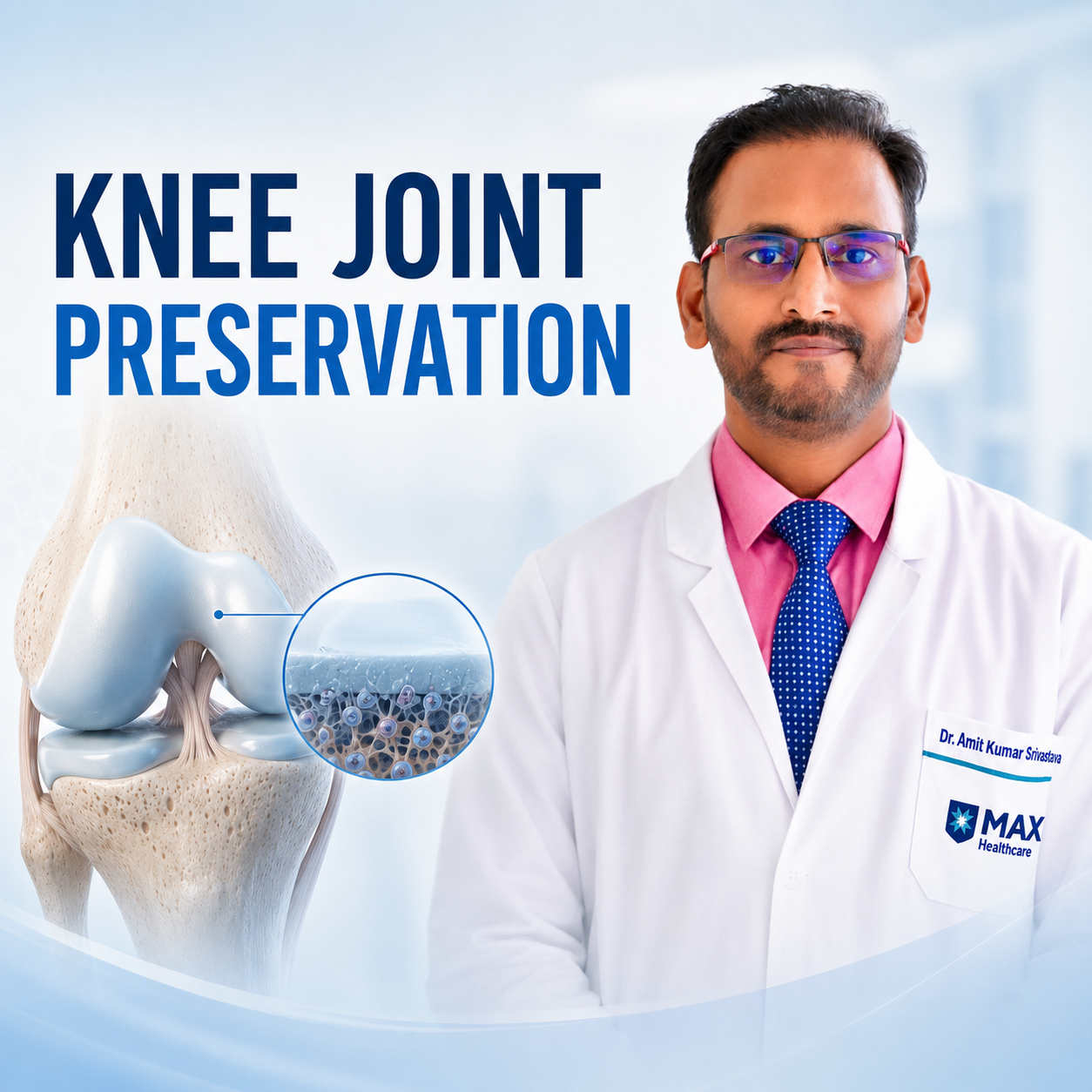
By Dr Amit Kumar Srivastava — Senior Orthopaedic Surgeon & Joint Preservation Specialist
Every year, in India alone, nearly 15% of adults over 60 struggle with chronic knee pain that limits daily movement, work, and quality of life. The conventional path for advanced arthritis has long been knee replacement surgery, but today, that is no longer the only option.
Modern orthopaedic science now offers a powerful alternative: knee joint preservation through cartilage regeneration. With treatments like Growth Factor Concentrate (GFC) therapy, regenerative orthopaedics is shifting the conversation from “when should I replace my knee” to “how can I keep my natural knee for life.”
If you have been advised surgery, or if you want to prevent that outcome before it is too late, this guide will explain exactly what is possible, who it helps, and what the science says.
What Is Knee Joint Preservation?
Knee joint preservation is a novel approach, focused on protecting, restoring, and maintaining the natural knee joint for as long as possible. Rather than replacing damaged tissue with an artificial implant, joint preservation strategies address the root causes of joint deterioration to delay or completely avoid knee replacement surgery.
Goals of Joint Preservation
- Reduce pain and inflammation.
- Restore cartilage health and joint function.
- Correct underlying biomechanical problems.
- Slow or stop the progression of osteoarthritis.
- Maintain an active, independent lifestyle.
Who Is an Ideal Candidate?
The best candidates for knee joint preservation are patients with early- to moderate-stage osteoarthritis (Grades 1–3), active adults under 60 who want to maintain physical performance, athletes recovering from cartilage injuries, and persons with mild to moderate osteoarthritis with reasonable alignment of the knee, in which the knee is more or less straight in the standing position.
Understanding Knee Cartilage and Why It Matters
Articular cartilage is the smooth, white tissue that covers the ends of the bones in the knee joint. It acts as a cushion absorbing shock, reducing friction, and allowing the knee to move freely. Healthy cartilage makes movement painless and effortless.
Cartilage has no blood supply, no nerves, and a very limited ability to repair itself. When it is damaged, whether by injury, wear and tear, or disease,e the damage tends to worsen progressively. As cartilage thins and breaks down, bone begins to rub against bone, causing the classic pain, swelling, and stiffness of osteoarthritis.
| Key fact: Cartilage damage rarely heals on its own. Without intervention, it typically progresses from early thinning (Grade 1) to complete bone-on-bone contact (Grade 4) over months to years. |
What Causes Cartilage Damage?
Cartilage breakdown rarely happens from a single cause. It is usually a combination of factors:
- Ageing — It causes cartilage elasticity and cell repair loss.
- Sports injuries — ACL tears, meniscus damage, and direct stress to the knee.
- Obesity — each extra kilogram puts 3-5 kg of stress on the knees when walking.
- Meniscus injuries — the meniscus acts as a supplemental stress absorber, and its loss causes cartilage degeneration.
- Joint malalignment — bow legs or knock-knees concentrates the stress on one side of the joint.
- Previous trauma — fractures or dislocations that disturb the joint surface.
Understanding your specific cause is critical. Effective knee joint preservation must target the underlying problem, not just manage symptoms.
Can Knee Cartilage Regenerate?
This is the question every patient asks, and the honest, science-based answer is: yes, to a significant degree, with the right treatment.
Cartilage cells (chondrocytes) do not replicate well on their own. The tissue lacks the blood vessels that would normally deliver repair signals. However, regenerative medicine has found ways to work around this limitation by delivering concentrated biological signals, particularly growth factors (GF ), directly into the joint.
Clinical research now confirms that targeted regenerative treatments can stimulate new cartilage matrix production, reduce inflammation that impedes repair, slow or halt the progression of osteoarthritis, and substantially improve pain and mobility.
The degree of regeneration depends on cartilage damage grade, patient age, body weight, and the treatment protocol used. Early intervention produces better results, which is why timing matters enormously.
Growth Factor Concentrate Therapy for Knee Osteoarthritis
What Is Growth Factor Concentrate (GFC)?
Growth Factor Concentrate (GFC) is a next-generation regenerative medicine generated from a patient’s blood. This highly purified preparation provides a concentrated dose of growth factors, including Platelet-Derived Growth Factor (PDGF), Transforming Growth Factor Beta (TGF-β), Vascular Endothelial Growth Factor (VEGF), Insulin-Like Growth Factor (IGF-1), and Fibroblast Growth Factor.
GFC differs from conventional Platelet-Rich Plasma (PRP) in terms of purity. The preparation process eliminates red blood cells and inflammatory white blood cells, leaving just platelets and their growth factors, which are the active healing agents. This makes GFC more powerful and less inflammatory than traditional PRP.
How Is GFC Prepared?
The GFC preparation process is safe, sterile, and done on the same day as the injection:
- A small sample of the patient’s blood (approximately 10ml) is drawn from the arm.
- The blood is processed using a double-spin centrifugation method to concentrate platelets.
- Red blood cells and inflammatory leukocytes are carefully removed.
- The resulting GFC is activated and prepared as a gel or liquid for direct injection into the knee joint.
- The entire process takes approximately 30–45 minutes and requires no synthetic additives.
How Does GFC Work?
When injected into the knee joint, GFC creates a localised, high-concentration environment of growth factors. These signals:
- Activate chondrocytes to produce new cartilage matrix (collagen type II and proteoglycans).
- Inhibit inflammatory cytokines (like IL-1 and TNF-α) that destroy cartilage.
- Stimulate synovial cells to improve joint lubrication.
- Promote new blood vessel formation (angiogenesis) that supports tissue repair.
- Reduce apoptosis (programmed death) of cartilage cells.
| Clinical insight: In my practice, patients receiving GFC therapy report significant pain reduction within 4–6 weeks and sustained functional improvement over 12–18 months, with many avoiding or substantially delaying the need for knee replacement surgery. |
Benefits of Growth Factor Concentrate Therapy
- Pain reduction: Within 6-8 weeks, most patients report a 50-70% decrease in discomfort.
- Improved mobility: Within 4-6 weeks, range of motion and walking capacity usually increase.
- Reduced inflammation: GFC actively reduces inflammatory pathways in the joint.
- Cartilage healing support: Documented evidence of cartilage matrix regeneration in early osteoarthritis.
- Delayed or avoided knee replacement: Many Grade 2-3 OA patients maintain joint health for 3-5 years post-treatment.
- Faster recovery: No hospital stay, no surgical risk; most patients resume light activities within 24-48 hours.
- Minimally invasive: A single injection in the clinic, conducted under ultrasound guidance for precision.
- Autologous and safe: Derived from the patient’s own blood, there’s no risk of allergic response or rejection.
Clinical Evidence Supporting Cartilage Regeneration
The evidence base for growth factor therapies in knee osteoarthritis has grown substantially in the past decade. Multiple peer-reviewed studies and systematic reviews have reported consistent findings:
- According to a 2021 meta-analysis published in the American Journal of Sports Medicine, GFC/leukocyte-poor PRP injections outperformed hyaluronic acid and placebo for pain relief and function in knee OA at 3, 6, and 12 months.
- A randomised controlled trial comparing GFC to regular PRP indicated that GFC had greater results at 6 months due to higher growth factor concentration and reduced white blood cell count.
- According to MRI-based studies, those who receive consecutive growth factor injections for early to moderate OA exhibit clear improvements in cartilage thickness and signal intensity.
- Long-term follow-up studies (24 months) show that more than 65% of patients who had GFC for Grade 2-3 osteoarthritis have had permanent functional improvement.
The current scientific consensus: GFC therapy is a safe, effective, evidence-supported option for early to moderate knee OA. It does not reverse severe (Grade 4) disease, but it is one of the most powerful tools available to stop the progression before that point is reached.
Other Knee Joint Preservation Treatments
GFC therapy works best as part of a comprehensive joint preservation program. Depending on the patient’s specific condition, this program may include:
- Physiotherapy: Strengthening the quadriceps, hamstrings, and hip abductors reduces joint tension and improves biomechanical alignment.
- Weight management: A 10% reduction in body weight can reduce knee joint load by 30-50%, greatly reducing cartilage degradation.
- Corrective osteotomy: A surgical treatment to straighten a malaligned knee and transfer load away from the injured cartilage, especially successful in younger individuals with isolated compartment OA.
- Meniscus Preservation: Repairing rather than removing a damaged meniscus to ensure long-term joint health.
- Cartilage restoration: Methods, including microfracture, OATS (osteochondral autograft transfer), and ACI (autologous chondrocyte implantation) for focal cartilage abnormalities.
- Orthobiologics: Hyaluronic acid viscosupplementation for joint lubrication and discomfort alleviation.
- Weight management: A 10% decrease in body weight can lower knee joint load by 30-50%, significantly reducing cartilage degeneration.
- Corrective osteotomy: A surgical procedure that straightens a misaligned knee and shifts the load away from the affected cartilage; particularly effective in younger people with isolated compartment OA.
- Meniscus Preservation: Repairing rather than removing a damaged meniscus to maintain long-term joint health.
- For focal cartilage defects, treatment options include microfracture, OATS (osteochondral autograft transfer), and ACI (autologous chondrocyte implantation).
- Orthobiologics: Hyaluronic acid viscosupplementation to improve joint lubrication and alleviate discomfort.
- Lifestyle adjustments include low-impact exercise, anti-inflammatory diets, and joint supplements (glucosamine, collagen peptides).
A well-designed joint preservation plan addresses not just symptoms, but the biological and mechanical factors driving disease progression.
Who Is the Best Candidate for Knee Preservation?
You are likely an excellent candidate for knee joint preservation if:
- You have been diagnosed with Grade 1, 2, or early Grade 3 knee osteoarthritis.
- You are under 60 and wish to maintain an active lifestyle.
- You are an athlete with a cartilage injury seeking to return to sport.
- You are experiencing knee pain but have not yet reached the bone-on-bone stage.
- You wish to delay or avoid knee replacement surgery.
- You have a single-compartment problem (medial or lateral OA) rather than global joint disease.
When Is Knee Replacement Necessary?
Knee replacement surgery remains an important and effective intervention for the right patient, but it is not the right intervention for everyone. Replacement is generally appropriate when:
- Grade 4 osteoarthritis, characterised by cartilage deterioration and bone-on-bone contact.
- A severe joint deformity that cannot be treated by realignment procedures.
- Comprehensive conservative treatment is ineffective beyond 6-12 months.
- Intractable pain that inhibits basic daily activities, even after biological treatment.
The fundamental principle is to avoid having knee replacement surgery too soon. Every year of preserved natural joint function is medically and functionally beneficial, and many patients who were advised they “must” have had wonderful results with knee preservation first.
Why Early Intervention Matters
The single most important predictor of knee preservation success is timing. Patients who seek regenerative treatment at Grade 1–2 OA have substantially better outcomes than those who wait until Grade 3-4.
Here is why early intervention changes everything:
- In Grades 1-2, the condition is reversible; cartilage can be meaningfully restored.
- Growth factors can trigger more viable cartilage cells while keeping the biological scaffold intact.
- Mechanical repair is simple: less joint injury means easier realignment.
- Why is the treatment cost for one GFC cycle lower than the lifetime cost of managing post-replacement issues?
- Quality of life improves quickly, with less pain, faster recovery, and a longer functional window.
| Do not wait for your knee to get worse before seeking help. By the time bone-on-bone pain is constant, 70–80% of your cartilage may already be gone. Act at the first sign of early arthritis, that is, when preservation works best. |
Frequently Asked Questions About Orthopedic Care
What is knee joint preservation?
Knee joint preservation is a medical and surgical technique that focuses on preserving and restoring the original knee joint in order to postpone or avoid knee replacement surgery. To preserve long-term joint health, it combines biological treatments (such as GFC therapy), physical therapy, weight control, and, in some cases, corrective surgery.
Can cartilage regenerate naturally?
Cartilage has very limited natural regenerating potential since it lacks a blood supply. Advanced regeneration treatments, such as Growth Factor Concentrate (GFC) therapy, can increase cartilage matrix formation and reduce or stop deterioration, particularly in early- to moderate-stage osteoarthritis.
What is Growth Factor Concentrate (GFC) therapy?
GFC treatment is a regeneration injection that is highly pure and derived from your own blood. It provides a concentrated dose of growth factors straight into the knee joint, reducing inflammation, stimulating cartilage repair, and improving joint lubrication without the use of synthetic medicines or surgery.
Is GFC better than a knee replacement?
GFC and knee replacement serve separate patient populations. GFC is most suited for early- to moderate-stage knee OA (Grades 1-3), while biological regeneration is still feasible. Knee replacement is indicated for severe, end-stage arthritis (Grade 4) with full cartilage loss. The idea is to use GFC to achieve the greatest feasible result while the joint is still salvageable.
How long does cartilage regeneration take?
Within 4-6 weeks of starting GFC therapy, the majority of patients notice pain relief and increased mobility. Cartilage matrix renewal, as seen on MRI, typically takes 6-12 months. A series of 2-3 injections spaced 4-6 weeks apart is often suggested for the best outcomes.
Who is eligible for cartilage regeneration treatment?
Adults with Grade 1-3 knee osteoarthritis, athletes with cartilage damage, and active people looking to prevent or postpone knee replacement are often good candidates. To determine eligibility, a complete orthopaedic evaluation with X-rays and an MRI is required.
Is knee preservation permanent?
Knee preservation greatly slows the advancement of osteoarthritis and can provide 5-10 years or more of functional joint health in well-chosen patients. It is not a cure-all, but it significantly increases the amount of time you may spend pain-free and active with your natural knee, and some people never need to have it replaced.
Can knee replacement be avoided?
Yes, for many patients with early to moderate OA, knee replacement can be avoided or substantially delayed with a well-executed joint preservation program combining GFC therapy, physiotherapy, weight management, and lifestyle modification. The earlier treatment begins, the better the chances of long-term success without surgery.
The Future of Knee Cartilage Regeneration
Regenerative orthopaedics is one of the most rapidly evolving fields in medicine. Within the next 5–10 years, patients can expect transformative advances, including:
- Personalised regenerative medicine: Growth factor protocols tailored to each patient’s genetics, age, and particular cartilage deficiency profile.
- Biological scaffolds: Injectable 3D scaffolds seeded with cartilage cells to fill focal cartilage lesions without requiring significant surgery.
- Stem cell therapy refinements: Improved mesenchymal stem cell methods lead to more predictable cartilage repair outcomes.
- Exosome therapy: Cell-free regeneration signals that may outperform current growth factor infusions in potency and precision.
- Precision orthopaedics: AI-driven imaging and biomechanical analysis to forecast which patients will benefit the most from which interventions.
We are at an inflexion point: for the first time in orthopaedic history, avoiding knee replacement is not just wishful thinking, it is a scientifically supported, clinically achievable goal for many patients.
Conclusion
Your natural knee cannot be replaced. While modern knee replacement surgery is a successful technique, it has limitations: implants wear out, activity restrictions apply, and recovery can take months. Whenever biologically possible, preserving your own joint is almost always the best long-term plan.
Growth Factor Concentrate therapy, combined with a personalised joint preservation protocol, now offers real hope to patients who were previously advised that surgery was their only option. The science is reliable. The findings are documented. And the sooner you start, the better your outcomes will be.
If you are experiencing knee pain, even if it feels manageable right now, do not delay evaluation. The window for effective joint preservation is not forever. Schedule a consultation with a knee preservation specialist to get a clear picture of your joint health and your options before arthritis progresses further.
Early action. Better outcomes. Your natural knee, for longer.
📞 Book Your Consultation with Dr. Amit Kumar Srivastava
Bonhomie Clinic, Yojana Vihar, East Delhi
Call: +91-9667134791
WhatsApp: +91-9667134791
Online Appointment: Speak to Our Care Coordinator
Early diagnosis leads to better outcomes. Take the first step today.